

New Category of Misconduct!

New Category of Misconduct!
…Is Benita Urey Abusing Her Chances of Seeking Redress?
The post-ban conduct of Ms. Benita Whitney Urey, following her five-year ban by the Liberia Football Association (LFA) for match manipulation, is raising growing concern among football governance observers. Beyond the original offense, her recent actions may be exposing her to a new and separate category of misconduct under international football rules, with implications for expanded sanctions and long-term exclusion from football administration.
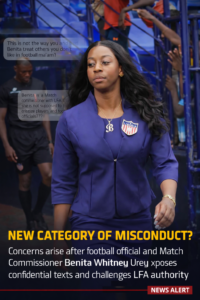
Ms. Urey is not only a club executive; she is also a recognized football stakeholder and Match Commissioner, a role that carries heightened ethical and professional obligations under FIFA governance standards. Additionally, she is widely known as the daughter of prominent Liberian businessman Benoni Urey, a background that places her actions under greater public scrutiny and reinforces the expectation of restraint, responsibility, and respect for institutions.
Ms. Ureyโ€™s original ban reportedly stems from violations related toย match manipulationย conduct addressed under Part II Offences, of the FIFA Disciplinary Code (Manipulation of Football Matches and Competitions 1 & 3), which treats such actions as among the gravest offenses in football with a fined of CHF 100,000. According to the provision, a longer ban, including potential lifetime ban on taking part in any football related activities, shall be imposed. However, disciplinary exposure does not end with the initial sanction.
Since the announcement of her ban, Ms. Urey has publicly posted the image of the LFA President upside down and has released what she claims areย confidential text exchangesย involving senior LFA officials, including the President. Under football governance frameworks, such behavior may constituteย independent post-decision violations.

Underย the FIFA Disciplinary Code (Misconduct), actions that bring the game into disrepute, show disrespect toward officials, or undermine the integrity of football institutions are sanctionable. When such conduct occursย afterย a disciplinary ruling, it may be treated asย aggravating behavior, not mitigation. In other words, it is regarded as contempt of court.
More critically, the disclosure of private communications, if she is even being truthful, raises concerns under theย FIFA Code of Ethics, particularly: General Duties, which requires all football officials to act with integrity and respect for the rules governing the sport;ย Duty of Loyalty, which obliges officials to safeguard the interests of football institutions; andย Confidentiality,ย which explicitly prohibits the disclosure of confidential information acquired in the course of official duties, unless legally required.
For aย Match Commissioner, these obligations are even more pronounced. Match Commissioners are trusted custodians of match integrity, reporting systems, and internal processes. Any conduct suggesting disregard for confidentiality or institutional respect may be viewed asย incompatible with the role itself, potentially justifying broader restrictions beyond a club-level ban.
International football governance offers clear precedent thatย post-disciplinary misconduct can lead to increased punishment: Senior football stakeholders in other jurisdictions have facedย separate investigations and possible suspensionsย for disclosing confidential information, even where no prior ban existed.
FIFA disciplinary bodies routinely treatย repeated misconduct, public attacks on officialsย as aggravating factors that justifyย extended bans or expanded scope of sanctions.
Underย Article 9 of the FIFA Disciplinary Code (Scope of Sanctions), disciplinary bodies retain discretion to increase penalties where conduct threatens the integrity or reputation of football.
In this context, continued public confrontation may expose Ms. Urey to additional proceedings, including the possibility that her current ban could be extended or broadened to cover all football-related administrative roles, domestically or beyond.
Ironically, such conduct may also undermine any appeal or review processย Ms. Urey might pursue. Appeals bodies, whether national, continental, or international, place significant weight onย good faith, procedural discipline, and respect for governance norms. Public provocation, symbolic affronts, and breaches of confidentiality can be interpreted asย bad-faith engagement, weakening credibility before any adjudicatory panel.
While it is the right of every individual to seek redress through lawful and institutional means, football governance is clear:ย status brings responsibility. As a Match Commissioner and a high-profile football stakeholder, Ms. Urey is held to a higher ethical standard, not a lower one.
In football, discipline is not judged only by the original offense, but by how one responds to it. Continued defiance of governance norms risks transforming a temporary sanction intoย a defining and lasting exclusionย from the game.
By: Alfred Morris

Leave a Reply

Your email address will not be published. Required fields are marked *