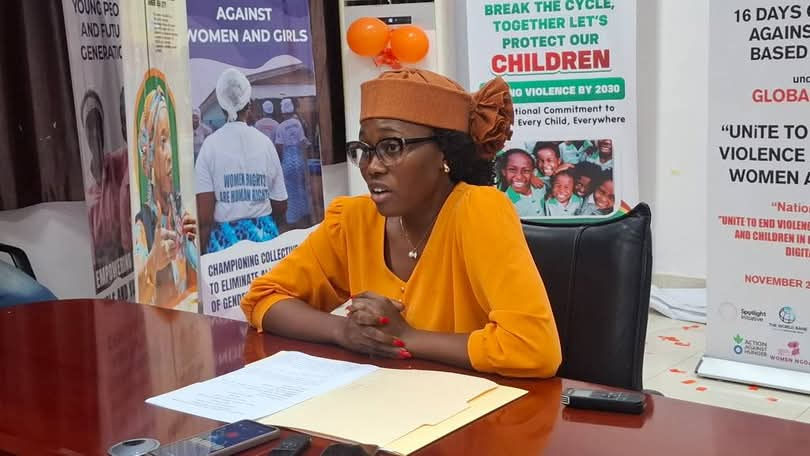
Liberia is grappling with a disturbing rise in rape and gender-based violence (GBV) cases, with Montserrado County recording the highest numbers for 2024 and 2025, according to new data released by the Ministry of Gender, Children and Social Protection (MGCSP). The report was presented on Sunday by Deputy Gender Minister Atty. Laura Golakeh during a pre-launch press conference for the 16 Days of Activism Against Gender-Based Violence.
Before her address, Atty. Golakeh asked the audience, including government officials, development partners, and members of the National GBV Taskforce, to observe a moment of silence in honor of victims who lost their lives to violence.
Deputy Minister Golakeh revealed that 3,591 GBV cases were recorded nationwide in 2024. Of those, 2,759 were rape cases, with Montserrado County alone accounting for 2,143 GBV inclusive of 1,902 rapes. This places Liberia’s most populated county at the epicenter of the crisis.
Other counties followed distantly: Lofa County: 313 GBV cases (218 rapes), Bong County: 196 cases, Nimba County: 165 cases, Grand Bassa County: 156 cases
Women represented the overwhelming majority of victims, 3,554 out of the 3,591 total cases, while only 37 male victims were recorded.
A particularly troubling statistic shows that statutory rape remains the leading category, with 1,485 cases involving victims under 18 years old.
According to the ministry, data from the first three quarters of 2025 suggests a continuing crisis. Between January and September:, Rape: 1,735 cases (56%), Physical Assault: 824 cases (26%), Domestic Violence: 339 cases (11%), FGM: 7 cases, Sodomy: 6 cases
“These figures are not just numbers, they represent shattered lives, broken families, and a national emergency that demands immediate action,” Golakeh said.
Liberia will officially join over 180 countries in launching the 2025 edition of the 16 Days of Activism Against Gender-Based Violence on Tuesday, November 25. The day begins with a parade from the Ministry of Health to the EJS Ministerial Complex, followed by the opening of a two-day National GBV Conference.
This year’s global theme is “UNiTE to End Digital Violence Against All Women and Girls.”
Liberia’s national theme is: “UNiTE to End Violence: Protecting All Women and Children in Our Communities and Digital Spaces.”
Atty. Golakeh stressed the significance of the campaign, which runs annually from November 25 to December 10:
“These 16 days remind us of the urgent need to confront the deep-rooted drivers of violence, patriarchy, harmful traditional practices, poverty, and institutional gaps.”
Despite daunting challenges, the Gender Ministry highlighted a series of achievements, including:
Review of the National Action Plan on GBV, Reactivation of the GBV 116 Call Center, Training for operators and County Gender Coordinators, Updated SGBV Referral Pathway, Local emergency funds for county coordinators, Strengthened GBV Taskforces across all 15 counties, Establishment of GBV Observatories in seven counties, Hiring of a GBV Data Analyst and implementation of the GBV Information Management System, Expansion of the EU–UN Spotlight Initiative 2.0 to eight counties
Golakeh said these actions are critical steps in building effective survivor-centered response systems nationwide.
Scheduled for November 25–26, the National GBV Conference will bring together key government agencies, development partners, traditional leaders, and civil society. Conference sessions will focus on: strengthening coordination at national and county levels, legal reform, and policy action, digital reporting systems and data management, financing and sustainable resource mobilization, Survivor-centered services and referral pathway improvements, and recent trends and risk mapping, including digital violence.
Golakeh explained that the 16 Days campaign remains crucial because GBV continues to erode the dignity, rights, and potential of women and girls in Liberia. She stressed that harmful cultural norms, early marriages, reliance on family settlements, and economic vulnerability keep many women trapped in cycles of violence.
“Violence against women and girls is one of the most widespread human rights violations,” she said. “Our participation in the campaign underscores Liberia’s commitment to building a society free of violence.”
The official campaign color is Orange, symbolizing hope for a future free of violence.
In her closing remarks, Golakeh expressed gratitude to President Joseph Nyuma Boakai, the EU, UN partners, and local organizations for supporting Liberia’s fight against GBV.
“As we intensify our national efforts, let us unite in purpose,” she urged. “We must ignite hope for a Liberia where every woman, every girl, and every child can live, grow, and thrive without fear.”
By: Alfred Morris
0770619113
Leave a Reply