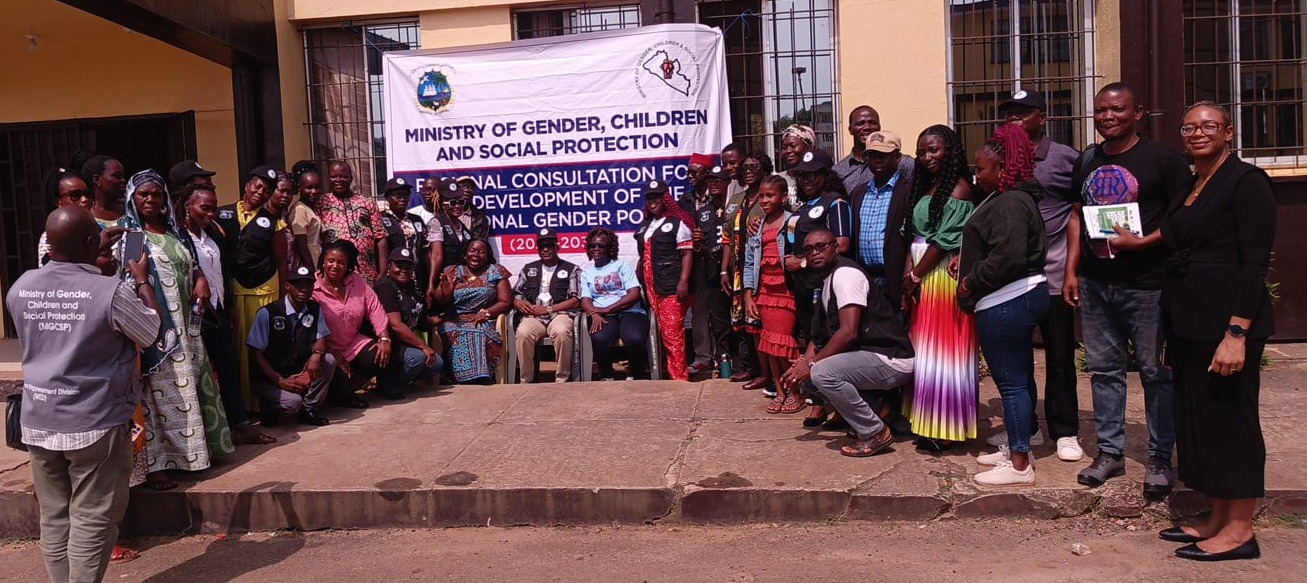
Gbarnga, Bong County – The Ministry of Gender, Children and Social Protection has continued its regional stakeholder consultations on the development of Liberia’s new National Gender Policy, with a high-level engagement held at the Gbarnga Administrative Building in Bong County.
Speaking at the opening of the Bong County phase, Deputy Minister for Research, Policy and Planning, Hon. Curtis V. Dorley, described the consultations as a critical step toward creating a policy that is inclusive, evidence-based, and responsive to the diverse realities across Liberia.
He explained that Liberia’s first National Gender Policy was developed in 2010 and later revised in 2017, but has since expired. An end-line evaluation of the policy recorded a 61.1 percent performance score, showing notable progress while also revealing significant gaps that must be addressed.
“The development of a new National Gender Policy is timely, especially as the country now operates under the ARREST Agenda for Inclusive Development,” Dorley said. He emphasized that gender equality is not a sectoral issue, but a cross-cutting development priority that directly affects economic growth, peacebuilding, and national cohesion.
According to the Deputy Minister, the new policy will cover a ten-year period (2026–2036) with a planned mid-term review. It will be shaped by stakeholder input from across the country. He urged participants to draw lessons from the previous policy, propose practical solutions, and strengthen partnerships to ensure sustainable results.
Dorley also highlighted Liberia’s national and international commitments to gender equality, including the ratification of CEDAW, the Convention on the Rights of the Child, and the enactment of key legislation such as the Children’s Law, Domestic Violence Law, Rape Law, and the National Action Plan on Women, Peace and Security.
He noted that the consultation process is designed to ensure broad participation from government institutions, civil society organizations, traditional leaders, the private sector, academia, and development partners such as the World Bank, UN Women, and UNDP.
The regional consultations bring together stakeholders from across the country and form part of a nationwide process to develop a gender policy that is actionable, measurable, and transformative.
The ongoing consultations are being funded by the World Bank through the Liberia Women Empowerment Project (LWEP).
Leave a Reply